Posts from ‘Developers’ Category
IGF 2012 Main Competition Finalists
By: Derek Yu
On: January 11th, 2012

The Main Competition finalists for the 2012 Independent Games Festival have been announced! The list is reprinted below and you can read some quotes from the jury here. TIGForums members are discussing the results in this thread.
IGF Entries Announced
By: Derek Yu
On: October 31st, 2011

On the main IGF site you can now view all of the 570 entries to this year’s Main Competition, including mobile games which are also eligible for a special mobile award. In years 2011-2007 there were 391, 306, 224, 173, and 143 entries, respectively. So yeah, a big year for the competition!
A couple weeks ago, I posted some of the new trailers I thought were cool, but TIGForums member esc has assembled a list of lists that makes it much easier to view all of the entries as well as their trailers.
Finalists in the competition will be announced in January 2012.
TIGJam 4: October 20th to 23rd
By: Derek Yu
On: August 24th, 2011

Our annual TIGJam is approaching! It’s once again taking place at the spacious Hacker Dojo in sunny Mountainview, California. Check the website for more information, including how to sign-up. The sign-up fee is $50 and pays for, among other things, a TIGJam t-shirt, refreshments during the Jam, and the traditional Indian dinner at the end. There are about 20 seats left, so git on it!
For the uninitiated, the jam lasts 4 days and is open to anyone interested in creating something, whether it’s a game, artwork, or music. You do not need to show up with a project in mind! Just be ready to build and play. Last year at TIGJam we played a lot of Street Fighter (IV and Third Strike) in between game-making and also held impromptu tournaments in Madhouse and NIDHOGG. There’s always a good chance of trying out some cool in-development indie games at TIGJam (or rediscovering old ones).
Many thanks to Matthew Wegner and Jeff Lindsay for organizing the jam, and thanks to Kyle Pulver for designing the jam’s website.
TIGForums: Get Togethers
KAG 70 and the End of Link-Dead
By: Derek Yu
On: June 27th, 2011
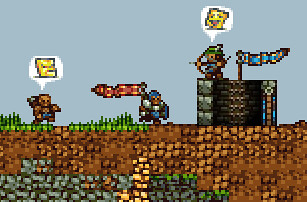
The development of the team-based multiplayer platformer King Arthur’s Gold continues at a fast clip, with builds 67 and 70 offering all kinds of new changes and features, like a capture-the-flag mode (now the default mode), an in-game map editor, and the addition of collapsible walls with improved physics (no more sky bridges!). What I only found out recently, however, is that the game rose quietly from the ashes of Link-Dead, Michał Marcinkowski’s dark and brutal sci-fi shooter. I had no idea!
Anyway, Michał goes into great depth explaining his reasons for dropping Link-Dead to work on King Arthur’s Gold, and as much as I enjoyed LD, it’s hard to argue against the success of KAG. The explanation is worth a read, if only for all of the insights into game design and development.
Stencyl
By: Derek Yu
On: May 31st, 2011
Stencyl is a newly-released, free game creation tool that comes with a suite of drag n’ drop editors to simplify the development and publishing of Flash games. There’s a big emphasis on collaboration – StencylForge and StencylTalk let you easily share resources and chat with other developers while you work on your project. For designers who are not so fond of drag n’ drop interfaces, there is a “code mode” for Stencyl’s game logic editor that can be used in conjunction with its simplified “design mode”.
The engine is based on Adam Saltsman’s Flixel library and it uses Box2d for physics. The logic editor is based off of the educational programming language Scratch.
Game Engines
By: Derek Yu
On: April 30th, 2011
There’s been quite a bit of news recently regarding game engines and game creation tools:
Monocle Engine – Monocle is a promising open source 2d game engine that’s being developed by Alec Holowka and Matt Thorson. The creators are inviting developers to jump in and help out.
CryENGINE – In an “open letter to the Crytek Modding Community”, Crytek’s Cevat Yerli announced (via Crymod) that a free CryENGINE SDK will be released to the public in August 2011. This free SDK will be well-documented and kept up-to-date with the advances being made to CryENGINE 3. Developers looking to sell their work digitally will be offered “an innovative low-cost licensing model”.
Adventure Game Studio – After 14 years, Chris Jones has released the source code to AGS, a popular tool for making point and click adventure games. It’s being released under the Artistic License 2.0.
Braid at GameCity 2010
By: Derek Yu
On: April 30th, 2011
In September 2010, at the UK game festival GameCity, Jonathan Blow spent over an hour playing through Braid and providing commentary. This is a shaky-cam recording of the session, which, according to Jonathan, is “by far the most I’ve said about Braid in one place”.
His current project is The Witness, a first-person puzzler – you can follow the game’s development here.
Bfxr
By: Derek Yu
On: March 29th, 2011
Stephen Lavelle’s browser-based extension of the free sound effects tool sfxr is complete, and has been dubbed “Bfxr“. Bfxr allows for the creation of more complex sound effects and includes features such as a mixer and a persistent list of created songs. A downloadable version is also available.
2011 IGF Award Winners
By: Brandon McCartin (BMcC)
On: March 2nd, 2011

Tonight, onstage alongside the esteemed Game Developers Choice Awards, the winners of the 2011 Independent Games Festival were announced. This lucky thirteenth year’s festivities were kicked off by now-veteran IGF Chairman Brandon “Real Brandon” Boyer, who you may know from Offworld, once one of the finest and most indie-friendly blogs around. (And source of countless aped posts back on TIGSource That Was.)

The ceremony proper was helmed by another Indie Apostle, Anthony Carboni of Bytejacker, perhaps the first host to date with actual hosting experience (nothing personal, Andy). And he did quite the bang up job! Of course, it just wouldn’t be the IGF Awards if the live feed‘s audio wasn’t mixed by a partially deaf clown. Despite Anthony’s every breath being the only thing audible, inside sources have confirmed that, yes, people did in fact laugh at his jokes.
There were quite a few memorable moments peppered throughout the show, some of which I’ve listed at the end of this post. And, while I didn’t stick around to watch, word on the street is Limbo and Minecraft grabbed a number of GDC awards as well. Yet another landmark year in the growing History of Indie Games! But enough prevaricating about the bush.
Indicated by pink superlatives, The 13th Annual IGF Award Winners are…
as3sfxr-b
By: Derek Yu
On: February 24th, 2011
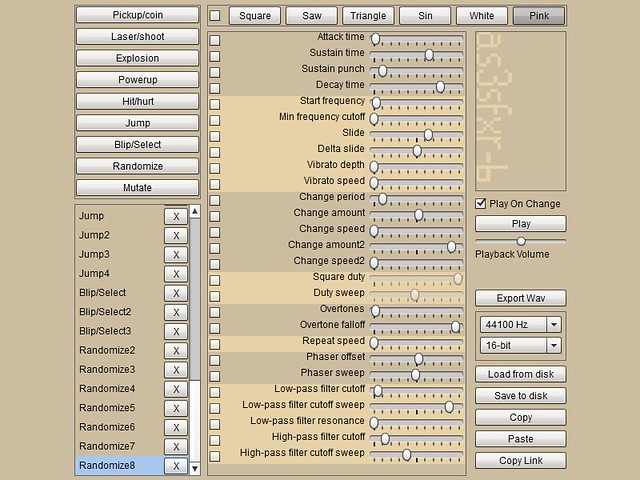
Increpare has modded Tom Vian’s Flash port of sfxr, a simple sound effects creation program by Dr Petter. Aside from the improved interface, as3sfxr-b adds a number of new features, including a playlist of created sounds, triangle waves, and the ability to share sounds with friends via a link. Increpare is currently taking suggestions for the app at this TIGForums thread.
Links: Tom Vian’s Flash Port, sfxr

The Independent Gaming Source: A community of independent game developers and players.


TIGForums DevLog Magazine
TIGForums Image Crawler: